
How AI Search Is Changing What Marketing Success Looks Like
For two decades, search marketing followed a simple pattern: rank well, earn the click, and turn visitors into enquiries. AI search summaries at the top of results have started to loosen that pattern. Answers now appear before the list of links, and many searches end without a visit to any website. For organisations that rely on being found online, the question is no longer only “how do we rank?” but also “how do we get understood, remembered and chosen?”
This article looks at what the evidence says so far, what Google has said about appearing in AI search results, and five practical steps that hold up whichever way search continues to change.
What the data shows about AI search and clicks
The most widely cited independent study of AI search behaviour comes from Pew Research Center. Its researchers tracked the browsing of 900 adults in the United States during March 2025 and analysed 68,879 unique Google searches. About 18% of those searches produced an AI summary.
The differences in behaviour were clear:
- On visits where an AI summary appeared, people clicked a traditional result link in 8% of visits. Where there was no summary, the figure was 15%.
- Links inside the AI summary itself were clicked in only 1% of visits.
- People ended their browsing session after 26% of visits with a summary, compared with 16% without one.
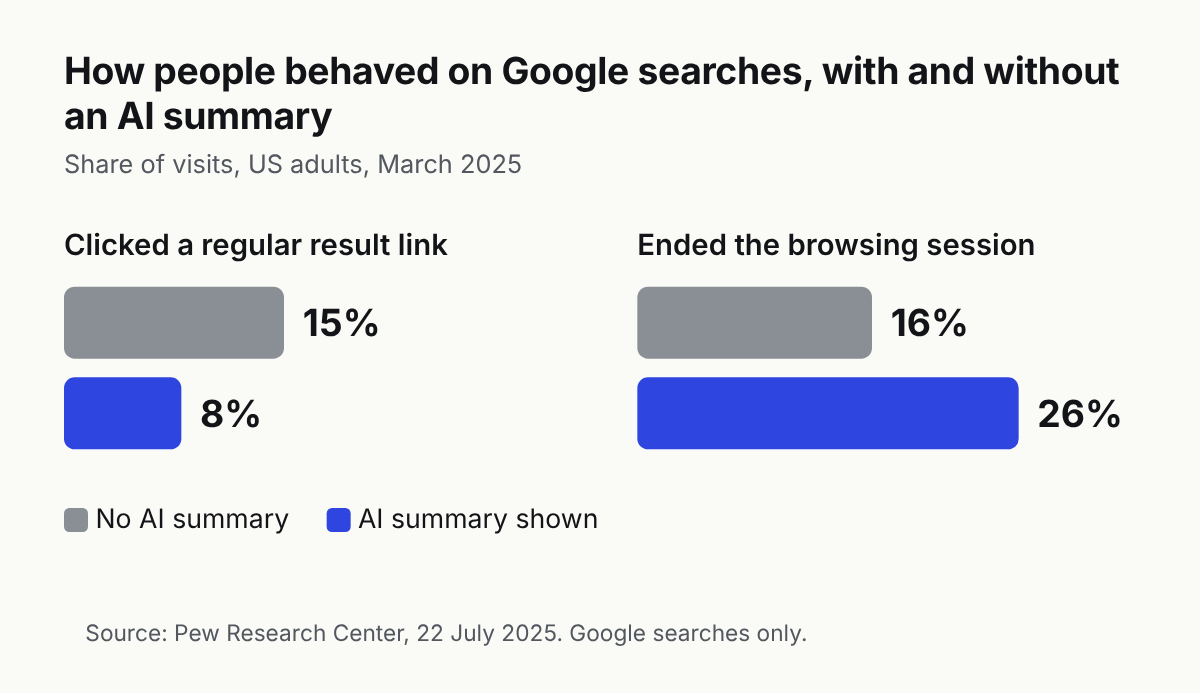
Some limits are worth keeping in mind. The study covered US adults, only Google, and a single month in early 2025. AI features have changed since then and will keep changing, so the figures are best read as a snapshot of a shift in behaviour rather than a fixed rule. The direction, however, is consistent with what many website owners report: when a search engine answers the question directly, fewer people need to click.
What Google says about appearing in AI search results
Much of the commentary around AI search suggests that a new kind of optimisation is needed. Google’s own documentation on AI features says otherwise. It states that there are no additional requirements to appear in AI Overviews or AI Mode, and that no special markup, AI-specific files or new structured data are needed.
The same page sets out what does apply:
- A page must be indexed and eligible to appear in Google Search with a snippet.
- Crawling must be allowed, including in robots.txt and any hosting or CDN settings.
- Important content should be available as text, supported by good images and video where relevant.
- Pages should be easy to find through internal links and offer a good page experience.
- Any structured data should match the text visible on the page.
Google also explains that these features may run several related searches across subtopics before building an answer, which means a wider and more varied set of pages can be shown than in classic results. In other words, a clear, well-organised page on a specific question has a fair chance of being surfaced, even if it is not the single top-ranking result for a broad term.
Why brand clarity matters more in AI search
When fewer visitors click through, the moments that remain become more valuable. A person might read a summary that names an organisation, see its name again in a different context, and later search for it directly. Visibility is increasingly built across several small exposures instead of a single click.
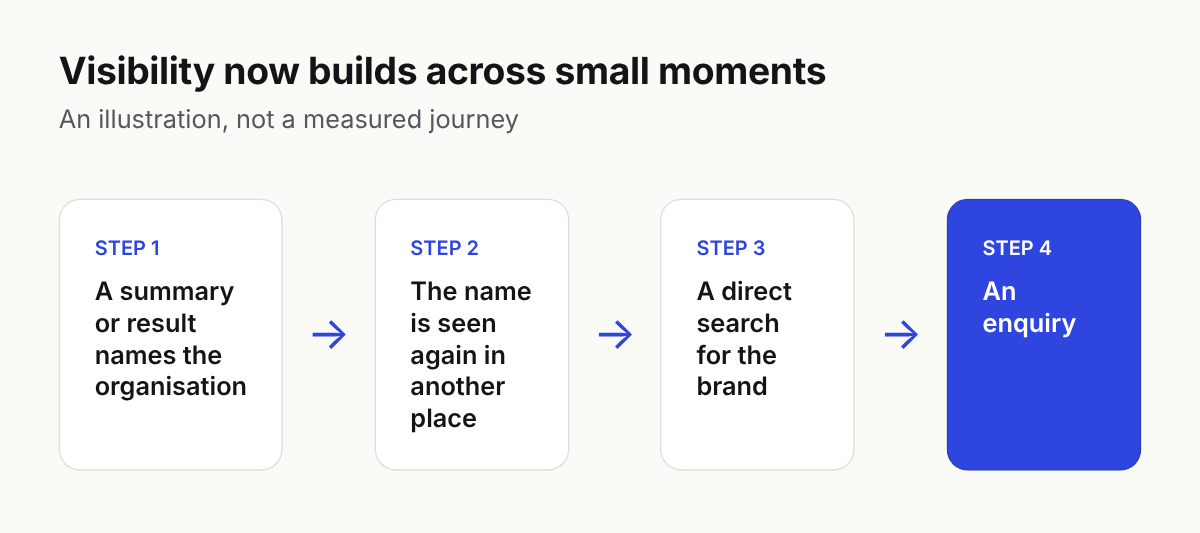
That puts weight on something marketing often treats as an afterthought: a plain, consistent explanation of what an organisation does, who it is for, and why it is credible. AI search systems and human readers both reward content that is specific. Vague claims are easy to skip, whereas a clear statement such as “marketing support for educational institutions and EdTech organisations” gives a search engine, and a person, something concrete to work with.
Five practical steps for AI search
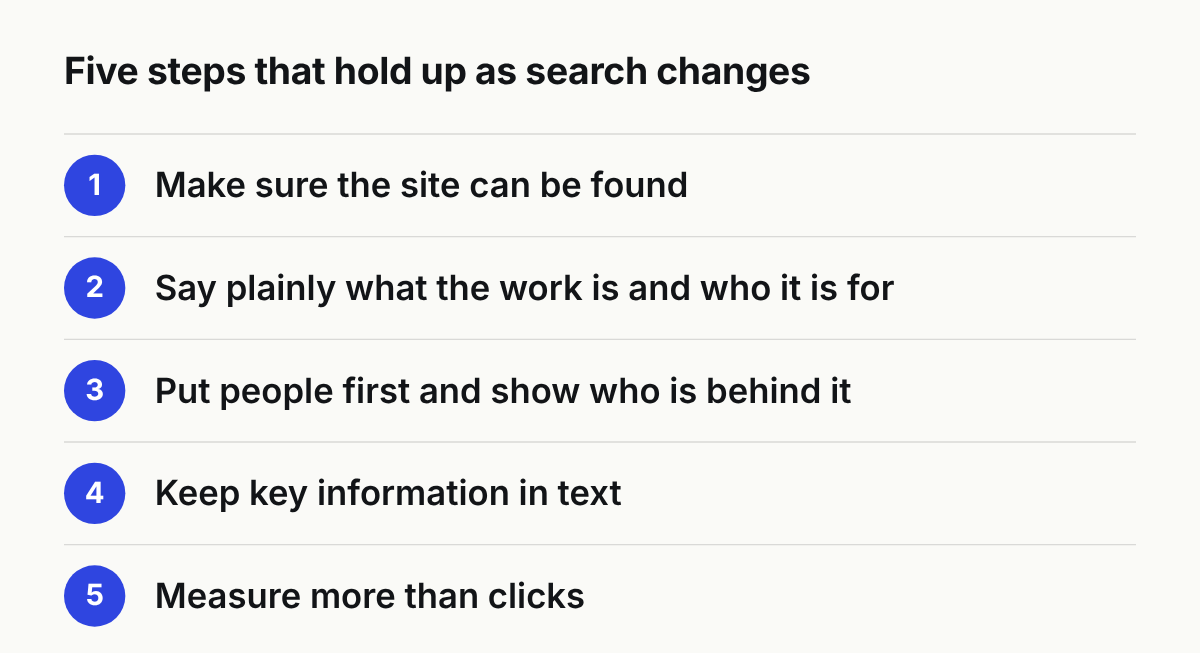
1. Make sure the site can be found at all
The basics still decide everything. Check that important pages are not set to “noindex”, that robots.txt is not blocking them, and that the site is verified in Google Search Console. A surprising number of sites are hidden by a setting that was switched on during development and never switched off. Google’s SEO Starter Guide, linked below, is a good checklist.
2. Say plainly what the work is and who it is for
For AI search and for people alike, write the main pages as if explaining the organisation to an intelligent stranger. Name the audiences, the types of work and the way projects usually begin. Avoid slogans that could describe any business. Specific, honest descriptions are easier to trust and easier to summarise accurately.
3. Put people first, and show who is behind the content
Google’s guidance on helpful, people-first content asks three useful questions: who created the content, how it was created, and why it exists. Clear authorship, transparency about the process and a genuine aim of helping readers are signals of trust. Content that only summarises other sources, or is produced in bulk to catch search traffic, is the kind that tends to fare badly.
4. Keep key information in text
Details that live only inside images, PDFs or scripts are harder for search engines to read. Programme details, services, contact routes and frequently asked questions should appear as ordinary text on the page, with images used to support them rather than replace them.
5. Measure more than clicks
If AI search gives more answers directly in results, traffic alone becomes an incomplete measure. Google notes that traffic from AI features is counted in the Web report in Search Console, so impressions and clicks can still be tracked. Alongside them, it helps to watch searches for the brand name, direct visits, and, most importantly, the number and quality of enquiries received.
What to avoid
Two temptations tend to appear whenever AI search or any other search feature changes. The first is to chase tricks, such as special files or phrasing meant to “speak to” AI systems. Google says none is needed, and anything that depends on a loophole can be undone by the next update. The second is to publish large volumes of thin content in the hope of covering every possible question. Fewer, more carefully written pages that answer real questions in depth are a sounder investment.
A note for education and EdTech organisations
Institutions and education technology providers are often asked the same questions repeatedly: course details, admissions steps, how a tool works, and what evidence supports it. Pages that answer these questions clearly, in plain text and with named authorship, are well suited to both readers and AI search. They also reduce the load on teams who would otherwise answer the same email many times.
The takeaway
AI search has changed how some people use search results, but the fundamentals have not moved far. Pages that can be crawled, say something specific, show who stands behind them and serve a real reader remain the foundation. What has shifted is the measure of success: being understood and remembered now counts for as much as being clicked.
For a deeper look at how marketing can be planned around clear objectives, see the Marketing page. For questions about a specific project, get in touch.
Further reading: Google’s SEO Starter Guide. Figures in this article come from the Pew Research Center study linked above.